Agents: What the Word Means and Why It Matters
The problem: The word "agent" is everywhere in AI discourse and means slightly different things in different contexts. For a researcher using Claude Code, it matters because it describes a fundamentally different mode of working — one where Claude takes sequences of actions on your behalf, not just answers a single question.
The basic distinction: chat vs. agent
Chat mode (classic Claude Desktop interaction):
-
You send a message
-
Claude responds once
-
Done — Claude waits for your next message
-
Claude has no tools, cannot act on anything outside the conversation
Agent mode (Claude Code):
-
You give Claude a task
-
Claude decides what steps are needed
-
Claude takes those steps — using tools, reading files, running commands, searching the web
-
Claude observes the results of each step and decides what to do next
-
Claude continues until the task is done, then reports back
-
You may not be involved between start and finish
The shift is from asking to delegating.
Why "agent" is the right word
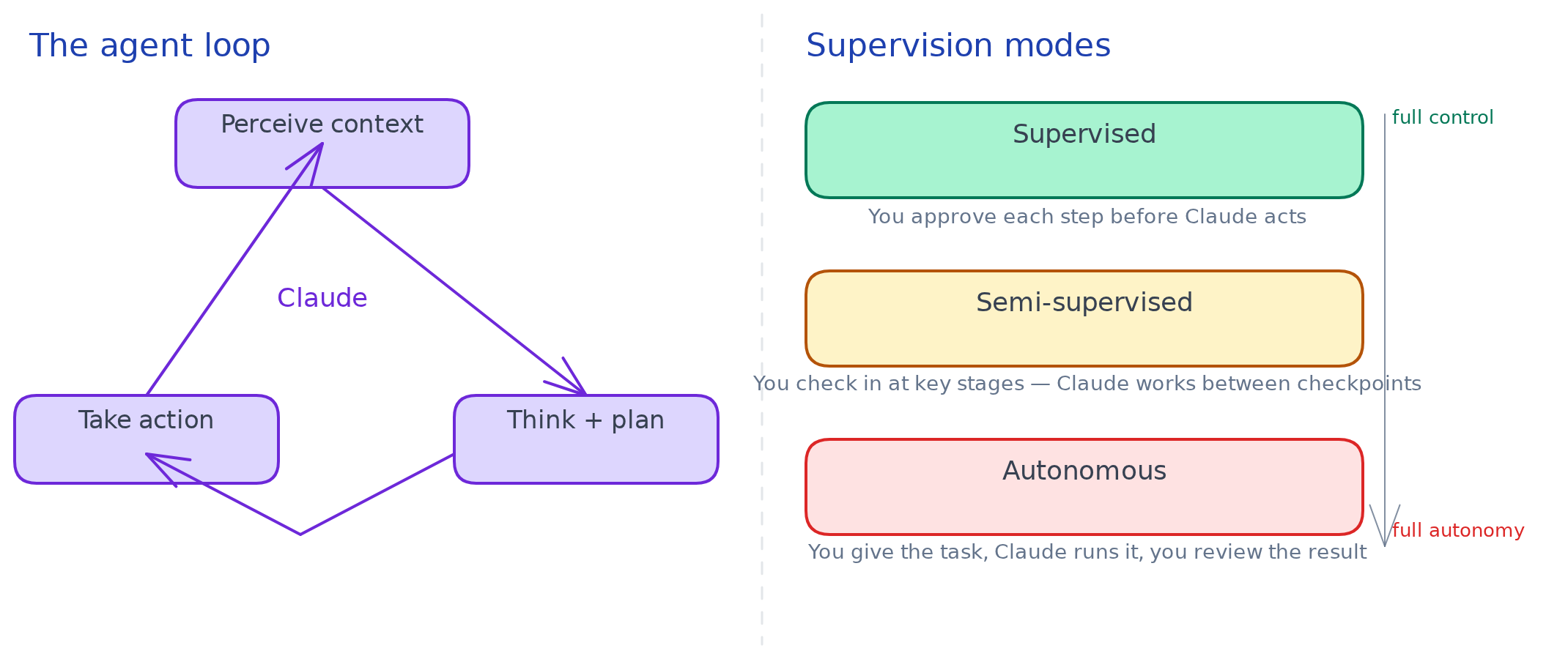
An agent, in the AI sense, is a system that: 1. Perceives its environment (reads files, fetches pages, runs commands) 2. Has goals (your instructions) 3. Takes actions to achieve those goals 4. Adapts based on what it observes
Claude Code is an agent because it does all four. When you say "go through this folder of PDFs and extract all named persons into a spreadsheet," Claude Code does not just answer the question — it acts: reads file 1, extracts names, reads file 2, extracts names, writes to spreadsheet, checks its work, adjusts if something went wrong.
Subagents
Claude Code can also spin up subagents — separate Claude instances delegated to handle parts of a larger task. You may notice Claude Code saying something like "I'll use an agent to handle this search." This is Claude Code parallelising work or protecting its own context window by offloading a subtask.
You do not need to manage subagents. They run transparently. But knowing they exist explains why sometimes Claude Code does more than you expected, or why a task runs for longer than a single exchange would take.
Using subagents deliberately for investigation: One of the most useful patterns from advanced Claude Code use is explicitly asking Claude to spawn a subagent for exploratory tasks — research, web searches, reading a large document set — rather than doing that exploration in the main session. This keeps the main context window clean for the actual work.
Practical form:
Investigate the secondary literature on Waldensian preaching in Lombardy
and summarise what you find. Run this as a separate investigation so it
does not fill our working context.
The investigation runs, Claude reports back with a summary, and the main session context is mostly preserved. This becomes relevant for longer work sessions where context pressure would otherwise force an early /compact or session restart.
The trust/supervision question
Agentic operation raises a practical question for researchers: how much do you let Claude run on its own?
This is not a philosophical question — it is a practical workflow decision with real consequences for your files and data.
Three modes of working with an agent
Supervised (step by step) You watch every tool call. Claude shows you what it is about to do; you approve or reject each step. Slower, but you see everything.
- Best for: first time doing a new type of task, sensitive or irreplaceable files, tasks where mistakes are hard to undo
Semi-supervised (review at checkpoints) Claude works autonomously, but you check in at logical stages — after it has processed the first few files, after it has produced a draft output. You correct course before it goes further.
- Best for: familiar tasks with recoverable outputs, batch work where you want to spot-check
Autonomous (let it run) You give Claude a task, it works, you review the result. You do not watch the process.
- Best for: well-defined tasks you have done before, non-destructive work (reading and summarising, not editing originals), tasks with easily reviewable outputs
What the far end of this spectrum looks like
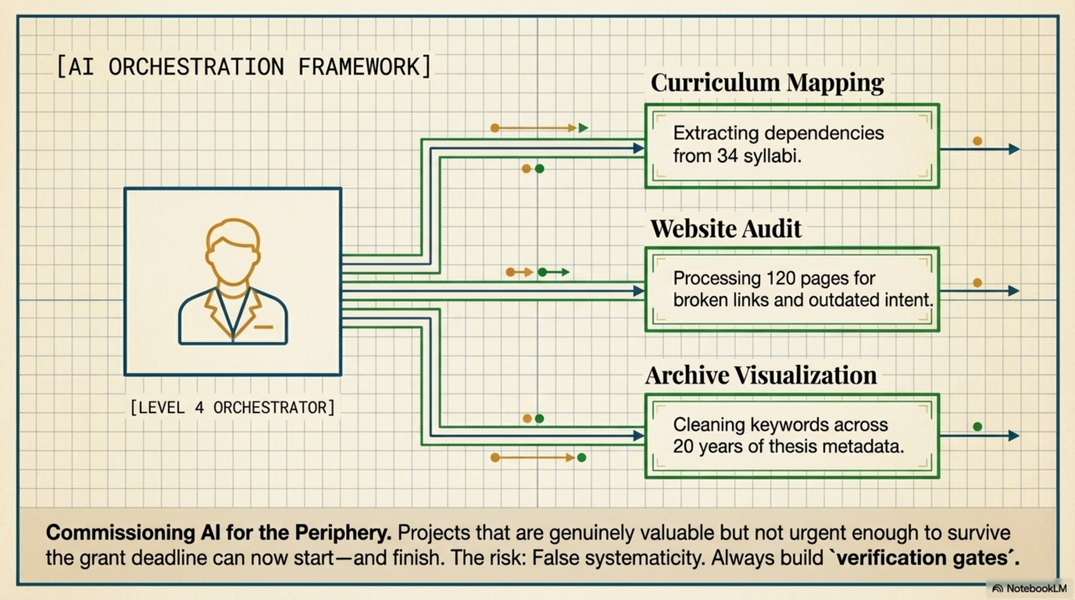
Beyond "autonomous" lies a fourth mode: fully orchestrated multi-agent autonomy. Oh My OpenAgent is a concrete example — a framework where you type a single command (ulw) and a team of specialised agents (an orchestrator, a planner, a deep worker) handles analysis, implementation, testing, and git commits without further human input. The system describes itself as "zero intervention, full autonomy."
For professional developers doing large codebase refactoring, this is a legitimate tool with a real use case. It is worth knowing about because it shows what maximum agentic autonomy looks like in practice — the logical endpoint of the delegation spectrum.
For researchers, it is the wrong model — not because automation is inherently bad, but because the decisions being automated are ones that require your judgment: interpreting a source, deciding what evidence means, committing to an analytical choice. When those decisions are delegated to an orchestrator agent, you have not saved research time — you have replaced research with process. The supervision modes above are not a compromise; they are the appropriate calibration for work that involves interpretation.
This principle holds even at the frontier of AI-for-research systems. Google DeepMind's AI co-scientist — a multi-agent system designed specifically to generate novel scientific hypotheses — is explicitly built around what its designers call the "scientist-in-the-loop" model: "The AI co-scientist is designed to operate with continuous human expert oversight, ensuring that final decisions are always made by scientists exercising their expert judgment." Maximum agentic autonomy is not the goal even in the most advanced research-AI systems. Human supervision at the interpretive level is the design choice, not a workaround.
Gottweis, J., Weng, W.-H., Daryin, A., Tu, T. et al. (2025). Towards an AI co-scientist. arXiv:2502.18864.
The key rule: never let an agent modify originals unsupervised
When Claude Code is processing documents, instruct it to write outputs to new files, never to overwrite your source material. This is the single most important safety practice for archival work.
Good pattern:
Read all PDFs in /sources/, extract person names, write results to /output/persons.csv
Do not modify any files in /sources/
Skills (tool-use extensions)
Related to agents: Skills in Claude Desktop (also called "tools" or "plugins") are pre-packaged capabilities you install. They extend what Claude can do — connect to Zotero, search the web, access a calendar.
In Claude Code, the equivalent is MCP servers (covered in the under-the-hood doc). The concept is the same: you give Claude access to a new capability, and it decides when to use it.
The difference is that in Desktop, Skills are discrete add-ons you enable. In Claude Code, MCP servers run in the background and Claude calls them as tools within its agent loop.
What can go wrong in agentic operation
Knowing the failure modes helps you supervise appropriately:
Hallucinated tool use — Claude reports doing something it did not actually do, or misreads a tool result. Rare but possible. Always verify important outputs.
Scope creep — Claude interprets your instruction broadly and modifies more than you intended. Mitigate by being specific: "only files in this folder," "do not edit originals."
Loop / getting stuck — Claude retries a failing step repeatedly. You will see this in the terminal. If it happens, interrupt (Ctrl+C) and rephrase the task.
Context overflow — On very large tasks, Claude may lose track of early instructions as the context fills. Break large tasks into smaller chunks.
Practical summary for researchers
| Situation | Recommended mode |
|---|---|
| First time processing a new document type | Supervised |
| Batch processing familiar material | Semi-supervised |
| Summarising (non-destructive) | Autonomous |
| Editing or restructuring files | Supervised |
| Working with irreplaceable originals | Always supervised + never modify originals |
The goal is not to maximally automate — it is to find the right level of delegation for each type of task, so you get the efficiency benefit without losing control of your research material.
Official documentation: code.claude.com/docs — agentic mode, tool use, and subagent patterns.
Related
-
A.concept.under-the-hood — how the agent loop works technically
-
A.critical.limitations — what goes wrong when you delegate too much
-
A.setup.settings-local — controlling what the agent is allowed to do
-
A13.examples-dissinet-usecases — supervised vs. autonomous modes in practice
-
B.autonomy — the long-term autonomy risks of getting delegation calibration wrong