B. Center and Periphery: Navigating the Known and the Novel
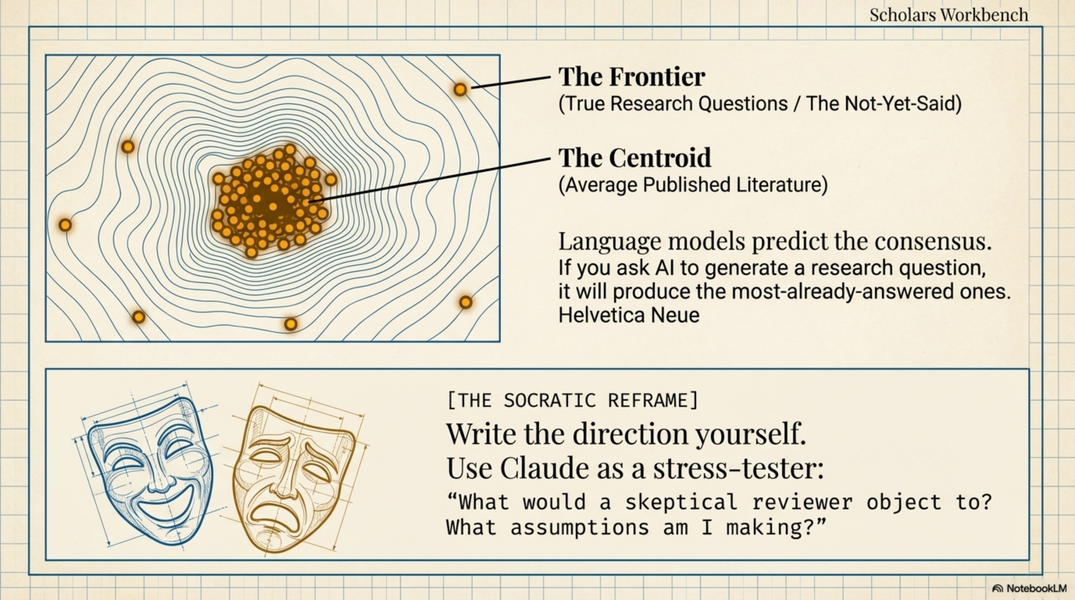
Purpose: The "centroid problem" — AI's tendency to produce the average of what has been published — is often presented as a straightforward danger to be avoided. This document complicates that picture. The centroid is not the enemy. Most research activity legitimately belongs near the center of a field, and AI is genuinely excellent at center work. The problem is more specific: AI creates gravitational pull toward the center even when you are trying to do frontier work, and it does so silently, making the drift hard to notice. The skill required is not "escape the centroid" but navigate deliberately between center and periphery — knowing where you are on that axis at any given moment, and choosing your AI relationship accordingly.
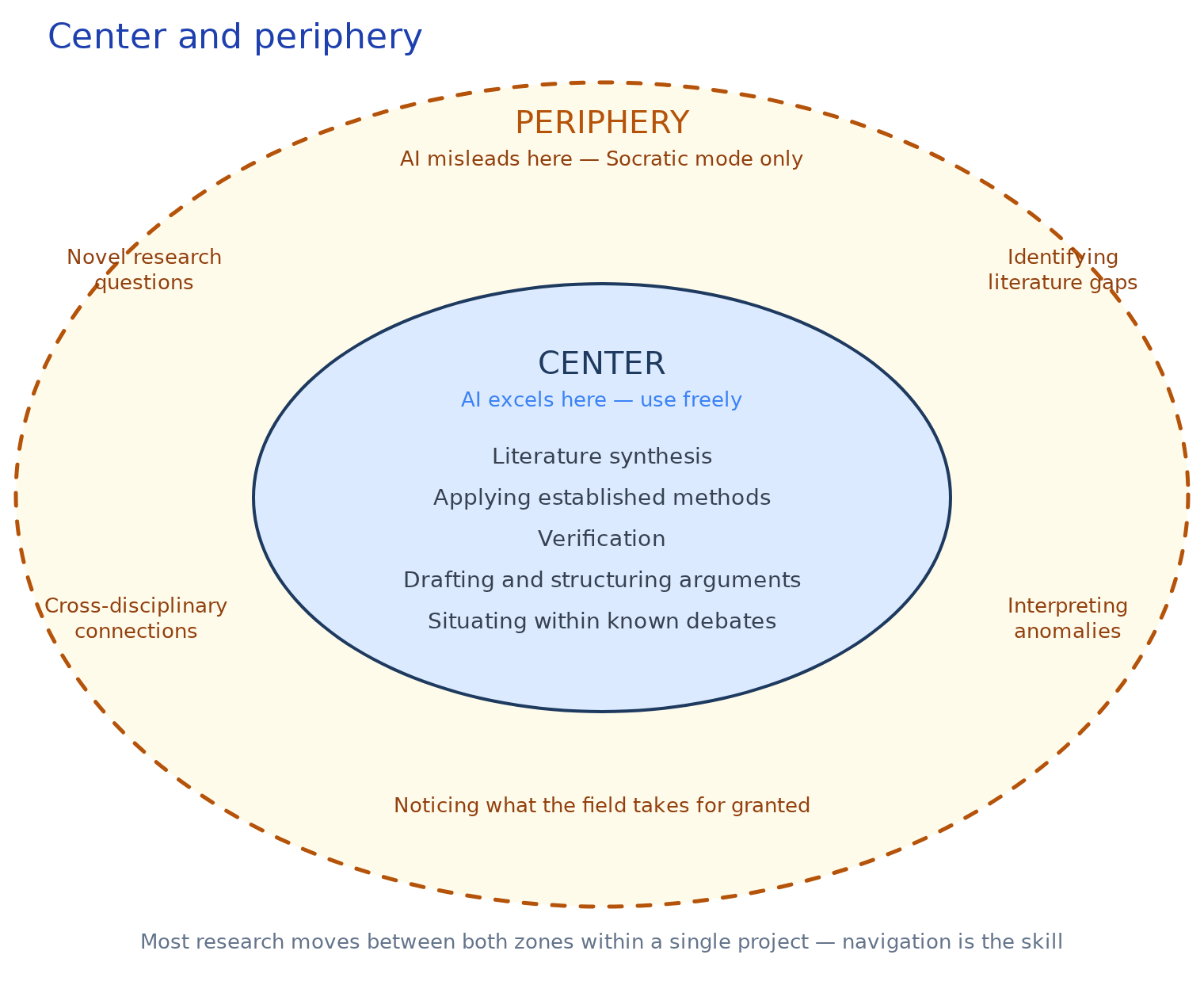
The center is not the enemy
Academic fields maintain themselves through center-work. Without it, knowledge does not cohere, accumulate, or transmit.
Center-work includes:
-
Reading what has been done and building explicitly on it
-
Applying established methods to new materials
-
Verifying your findings against prior results
-
Situating your contribution within recognised debates
-
Synthesising the literature accurately and completely
-
Communicating in forms your community recognises
This is not second-rate research. It is how fields work. A paper that makes a small, carefully grounded contribution to a well-established debate is doing important intellectual work. A methodology section that correctly deploys a standard method is not being unambitious — it is being rigorous. A literature review that accurately maps the existing terrain is doing what literature reviews are for.
The researcher who believes they must always be at the frontier, and therefore treats all center-work as intellectually beneath them, will produce work that floats above the field without connecting to it. Contribution requires grounding. You can only navigate to the periphery from the center.
AI is genuinely good at center-work. Synthesis, consolidation, formatting, verification, mapping established debates, applying standard methods to new instances — these are precisely the tasks where Claude's statistical picture of published literature is an asset rather than a liability. Use it freely here.
The periphery is where contribution happens
But fields do not advance from the center. They advance from the edges — from researchers who notice what the field has taken for granted, who bring methods from outside, who find the anomaly that the dominant framework cannot accommodate, who ask the question that has not been asked.
The tension between center and periphery is not a problem invented by AI — it is a structural feature of research. Google DeepMind's 2025 paper on their AI co-scientist opens by naming it directly: researchers "are faced with a breadth and depth conundrum. The complexity of topics requires increasingly deep and specific subject matter expertise, while leaps in understanding come from trans-disciplinary thinking that synthesises knowledge across domains." This is why large-scale AI-for-research tools are being built: to help researchers synthesise across the center faster, so they can spend more cognitive resources at the frontier. The argument here is the same, at the scale of a single researcher with a single Claude session.
Gottweis, J., Weng, W.-H., Daryin, A., Tu, T. et al. (2025). Towards an AI co-scientist. arXiv:2502.18864.
Peripheral work includes:
-
Forming a research question that addresses a gap not yet filled
-
Identifying that what the field assumes to be settled is actually contested
-
Making a cross-disciplinary connection that has not been made
-
Finding that the accepted method does not fit your specific material
-
Noticing the anomalous source that the existing literature cannot explain
-
Arguing that the field has been asking the wrong question
This is where training data runs out. The periphery, by definition, is what has not yet been consolidated, cited, synthesised, or published in sufficient quantity for a language model to learn it. The conference discussion that has not yet become a paper. The debate between scholars that has not yet resolved. The emerging method that has not yet accumulated enough examples to be well-represented in training data.
AI cannot see the periphery from inside. It can simulate novelty — generate unexpected juxtapositions, propose cross-disciplinary analogies, surface connections between distant literatures. But what it produces is drawn from what has already been written, which means the "surprising" connections it makes are ones that have already been made, at least in some form, somewhere in its training data. The genuinely unexpected connection is the one that has not yet appeared in print.
The navigation problem
Research moves constantly between center and periphery, often within a single project and sometimes within a single working session. A productive research day might involve:
-
Synthesising a section of literature (center work — AI is excellent)
-
Checking your method against established practice (center — AI is excellent)
-
Drafting text around a settled argument (center — AI is excellent)
-
Returning to your research question to check whether it is still pointing where you want (periphery — AI in Socratic mode only)
-
Noticing that an unexpected finding complicates your argument (periphery — AI cannot generate this; you found it)
-
Figuring out what that finding means (interpretive frontier — AI in stress-testing mode only)
The danger is not that you do center-work with AI assistance. The danger is losing track of where you are on the axis, and defaulting to center when you meant to be at the frontier.
This happens in specific ways:
The tractability drift. You have a rough peripheral intuition — a sense that something interesting is happening at the edge of what the literature has addressed. You open Claude to help develop it. Claude helps you find a formulation that is cleaner, better-supported, and more recognisable. The formulation it finds is cleaner precisely because it is more central — it resembles what the field already knows how to talk about. You accept the cleaner formulation. Your peripheral intuition has been replaced by a central one, and the replacement felt like improvement.
The confidence asymmetry. A centrally-framed question, expressed with AI's characteristic fluency and confidence, feels more compelling than your own rough peripheral intuition. This is not because it is better. It is because fluency and confidence feel like correctness. The rough intuition may be pointing at something real; the fluent formulation is pointing at something already known.
The invisible transition. The transition from "using AI to explore my existing rough idea" to "following AI's refinement of my idea" can happen without a visible decision point. You were driving; now Claude is driving; the change happened gradually through a series of small "yes, that's better" responses.
AI and the center-periphery axis
The relationship between AI assistance and research position on the center-periphery axis is not uniform. It varies by what you are doing.
| Activity | Position on axis | AI relationship |
|---|---|---|
| Literature synthesis | Center | Use freely — this is exactly what AI does well |
| Applying established methods | Center | Use freely — calibrate against standard practice |
| Argument structure and drafting | Center–Mixed | Use for scaffolding; watch for voice and framing drift |
| Identifying gaps in the literature | Mixed–Periphery | Use AI to map the center; gaps are what's missing from the map |
| Research question formation | Periphery | AI in Socratic mode only; generate the question yourself first |
| Interpreting anomalous findings | Periphery | AI as sounding board; you hold the interpretation |
| Cross-disciplinary connection-making | Periphery | AI can generate connections; only you can evaluate whether they are genuine |
| Noticing what the field takes for granted | Periphery | AI cannot do this — it embodies the assumption |
Knowing which row you are in is the navigation skill. When you are in the top three rows, AI assistance is appropriate and efficient. When you are in the bottom four, the relationship changes — AI is useful for stress-testing and logistics, not for direction.
What AI can do at the periphery
This is not an argument that AI is useless for frontier work. It is an argument for a different mode of use.
Stress-testing your peripheral intuition. Once you have a rough sense of a gap, a novel connection, or an unexpected finding, Claude can help you pressure-test it: What is wrong with this? What has already been written that gets close to this? What would a sceptical reader say? Why might this not be as novel as I think?
The key is that the direction — the rough peripheral intuition — is yours. Claude tests it; Claude does not generate it.
Mapping the center so you can see its edges. Asking Claude to describe the main positions, debates, and open questions in a field is useful for frontier work — not to find your question, but to know what the center looks like, so you can identify what it is not seeing. The map of the center reveals the blank spaces at the edges.
Processing the logistics of frontier work. Peripheral work still involves center-work logistics: formatting, note-organisation, cross-referencing, drafting around your interpretations. AI handles these efficiently, freeing your attention for the interpretive and generative work that only you can do.
Detecting when you have drifted centripetally. Explicitly ask: Has my question shifted toward something more central in the last hour? Did I accept a reformulation because it was better, or because it was more fluent? This is not something Claude does automatically — you have to ask.
The practical habit: name your mode
Before opening Claude, name where you are on the axis.
"I am doing center-work right now — synthesising the literature on X. AI assistance is appropriate and I should use it fully."
"I am doing frontier work right now — trying to figure out whether this anomaly is pointing at something important. I will use AI for logistics and stress-testing, not for direction."
"I am transitioning from center to frontier — I have done the synthesis, I am now trying to find the gap. I will use AI to show me the map; I will look for what is missing from the map myself."
The naming is not for Claude's benefit. It is for yours. It creates a brief moment of deliberate positioning that interrupts the default of always using AI the same way regardless of what you are doing.
The mode-switch rule: When you move from center to frontier within a session, explicitly change the AI relationship. You do not need to start a new session, but you do need to notice the transition and adjust: switch from "help me develop this" to "help me test this" or "leave me to work; I will come back when I need stress-testing."
The team dimension
When a research team is working on both center and frontier problems simultaneously — which is the normal condition for active research groups — the navigation challenge multiplies.
Different team members may be at different positions on the axis at the same time: one is consolidating the literature (center), another is developing the new research question (frontier). If both are using AI assistance in the same mode, the frontier worker's question will be pulled centripetally even as the center worker's synthesis is correctly stabilised.
The team norm that matters: make the axis position of each piece of work explicit. When you share a document or bring a finding to a team meeting, name whether it is center-work (building on established ground) or frontier-work (pointing somewhere new). This affects how colleagues should engage with it and how AI assistance should have been calibrated in producing it.
→ See B.team-ai for the collaborative dimension of AI-assisted work; the center-periphery axis is the epistemic complement to the trust and disclosure concerns discussed there.
Related
-
B.lifecycle.1.creativity — the creative moment as the most explicitly frontier phase; Socratic mode and the centroid problem in question formation
-
B.epistemics — the tunnel effect and confirmation loops as mechanisms of involuntary centroid capture
-
B.autonomy — agenda drift as the long-term version of centripetal pull: research questions migrating toward AI-tractable center-work
-
B.lifecycle — the full lifecycle; center-work and frontier-work are distributed differently across phases
-
C.dangers — the centroid problem in the danger taxonomy; this document provides the reframing that makes the danger specific
-
A15.agent-personalities — the Socratic Dialogue Partner and Devil's Advocate personalities as tools for frontier-work AI engagement