B. Literature Engagement: Finding, Synthesizing, Interpreting
Purpose: Working with existing literature is the second fragile moment in the research lifecycle. It looks like a mechanical task — search, read, organise, summarize — but it contains a sharp internal distinction that determines whether AI involvement is productive or misleading. This document maps that distinction and describes what good AI-assisted literature practice looks like.
Part of the B.lifecycle series.
The core distinction: finding vs. synthesizing
Literature engagement involves at least three separable activities:
- Finding — locating relevant work that exists and that you should know about
- Synthesizing — making sense of what you have found: themes, tensions, positions, gaps
- Interpreting — deciding what the literature means for your specific question
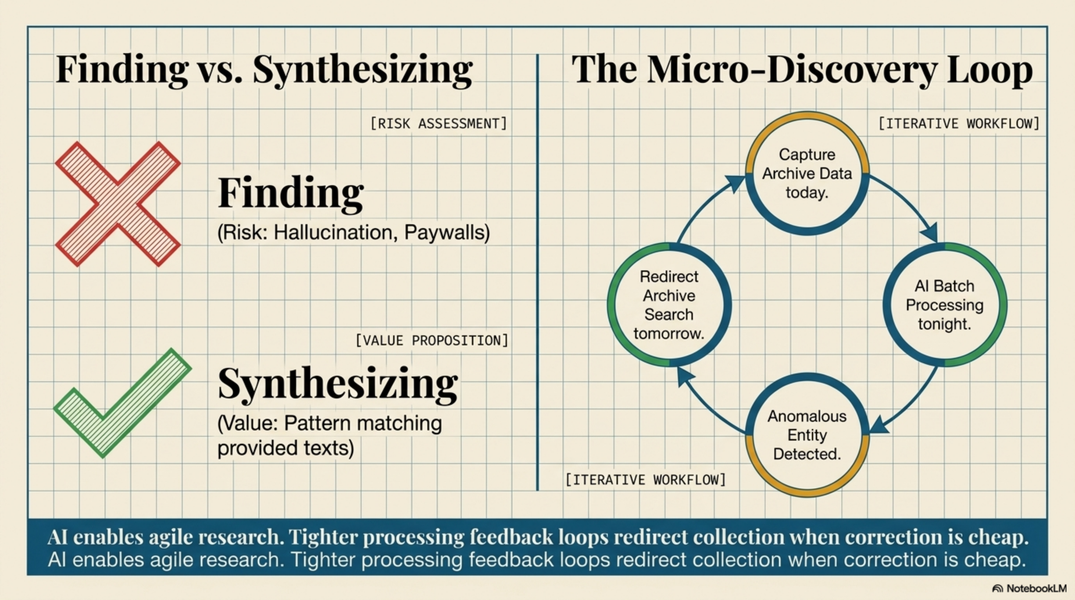
AI is weak at finding, strong at synthesizing, and fragile at interpreting. Using it without this distinction leads to two common mistakes: expecting Claude to reliably find you literature (it will not), and mistaking Claude's synthesis for interpretation (it is not).
Finding: the structural limitations
Literature finding looks like a mechanical task — search for papers, filter by relevance, build a list. But AI faces structural limitations that make it unreliable for this:
Training cutoff. Claude's knowledge ends at a point in the past. Recent papers — often the most relevant, most contested, and most field-defining — are simply not there. In fast-moving fields, a training cutoff of even eighteen months can mean missing the papers that are currently reorganising how people think.
No paywall access. Most of what academic fields have published is behind journal paywalls. Claude can only draw on what appeared in open-access sources or was otherwise represented in its training data. For most disciplines, this is a fraction of the actual literature.
Hallucination risk. Claude can generate plausible-sounding citations — author, title, journal, year, DOI — that do not exist. This is one of the most consistently documented failure modes in AI use for research. The references look real. They are not. Never use a Claude-generated reference without independently verifying that the source exists and says what Claude claims.
Field-specific thinness. In specialist sub-fields, Claude's picture of the literature may be sparse and overconfident. It knows the major general works; it may not know the specialist debates, regional journals, or conference proceedings that matter to your question. Overconfidence is particularly dangerous here: Claude will describe a sub-field's literature as if comprehensively, without signalling the gaps in its own knowledge.
What Claude is useful for in finding: Initial orientation in a field you are entering for the first time — a rough first sketch of major positions, key figures, foundational texts. Treat this as a starting point for a real search, not as the search itself.
What to use instead: Database searches — Scopus, Web of Science, JSTOR, Google Scholar, field-specific databases — for finding current and specialist literature. Your own reading and your colleagues' recommendations for the frontier. Zotero for managing what you find.
Synthesizing: what AI does well
Synthesizing literature you have already collected is a fundamentally different task from finding it, and AI performs it genuinely well.
Given a set of papers, notes, or abstracts you provide, Claude can:
-
Identify recurring themes and map how different works relate to each other
-
Surface tensions and disagreements between positions that you may be too close to see
-
Propose a structure for a literature review section
-
Draft structured summaries of individual sources
-
Find connections between texts in your collection that you have not noticed
-
Identify what is conspicuously absent from a body of literature — what has not been asked
The quality of the synthesis depends entirely on the quality of what you bring in. Claude synthesizes what you give it; it cannot know about work you have not yet collected. This means the synthesis is only as good as your Zotero library — which is why building and maintaining that library is the researcher's indispensable work, not something AI can substitute for.
The Zotero connection
A well-maintained Zotero library is the infrastructure that makes AI-assisted synthesis powerful. When you bring your curated collection into a Claude session — through direct export, through notes, or through the Zotero integration described in A10 — Claude has access to a body of literature that reflects your intellectual judgment about what is relevant to your questions. It synthesizes your curation.
This also means: the earlier you start building the library and the more consistently you maintain it, the more useful AI-assisted synthesis becomes as the project develops.
Interpreting: the limit of synthesis
Synthesis is not interpretation. Claude can tell you what the literature says — what positions exist, how they relate, where tensions lie. It cannot tell you what the literature means for your specific research question.
Interpretation requires:
-
Your field position: a judgment about which tensions are live and which are resolved, which figures are central and which are peripheral, where the field is actually going
-
Your specific question: the interpretive relevance of any piece of literature is determined by what you are trying to argue, and that is yours
-
Your judgment about what is central and what is noise in the current state of the debate
A literature review that Claude synthesized but did not interpret is a map without a destination. You can see all the roads; you still have to decide where you are going and why.
The practical signal: if your literature review could have been written by someone who had read the same papers but had a completely different research question, the interpretation has not been done yet.
Verification: non-negotiable
Regardless of how you use Claude in literature work, independent verification of citations is non-negotiable.
Before including any source in your work that came from or was confirmed by Claude:
-
Verify that the source exists (search the title and author independently)
-
Verify that it says what Claude claims (read the abstract or relevant passage yourself)
-
Verify the bibliographic details (author names, year, journal, volume, page numbers)
This takes time. It is not optional. The consequences of building an argument on a hallucinated source range from embarrassing to career-damaging, depending on where the work ends up.
A practical workflow: use Claude for synthesis and structure, keep a running list of sources to verify, verify before finalising. Do not leave verification to the end of the project.
The recency problem: a practical workaround
The training cutoff means Claude's literature knowledge ages continuously. For fields where recent work matters — most fields — this is a real limitation.
A workable workaround: use Claude for the literature you have already collected (where the cutoff is irrelevant because you are bringing the sources in), and use database searches for systematic coverage of recent work. The two approaches are complementary, not competing. Claude handles synthesis across what you have; the databases find what is new.
For staying current in a field without reading everything: journal table-of-contents alerts, Google Scholar citation tracking for key papers, and direct engagement with the people producing the frontier work remain more reliable than AI-assisted monitoring.
Related
-
B.lifecycle — the full lifecycle map; this document covers literature engagement in depth
-
B.lifecycle.1.creativity — research question formation: the moment that literature engagement feeds into
-
A10.claude-and-zotero — Zotero integration in practice: bringing your library into Claude
-
A.critical.limitations — hallucination in citations: the documented failure mode this document's verification guidance addresses
-
B.autonomy — atrophied judgment: the risk of outsourcing literature synthesis until you can no longer evaluate what you are reading