B. Assessing Ownership: What Did Claude Do, and What Did You Do?
Purpose: The ownership question raised in B.experience is real but abstract — you feel more or less like the author. This document makes it concrete: how to actually assess the distribution of work between you and Claude at the end of a session, and what role Claude itself can play in that assessment.
Why assess ownership at all?
Three practical reasons, not abstract ones:
Disclosure. Journal and funder policies, MUNI guidelines, and your own integrity require you to be able to describe AI's role in your work. "I used Claude" is not a description. "Claude drafted the initial structure of Section 2; I rewrote the argument and all the evidence; the framing in the introduction is mine" is one.
Self-calibration. Over time, your sense of your own contribution drifts. Work that felt collaborative at the time looks, in memory, like your own — or vice versa. Pausing to assess while the session is fresh is more accurate than reconstructing it later.
Defence readiness. In a thesis defence, peer review, or seminar, you will be questioned on your work. The question to ask yourself is not "can I defend this?" but "which parts of this can I defend without hesitation, and which parts would I have to reconstruct?" The latter are the parts where ownership is thin.
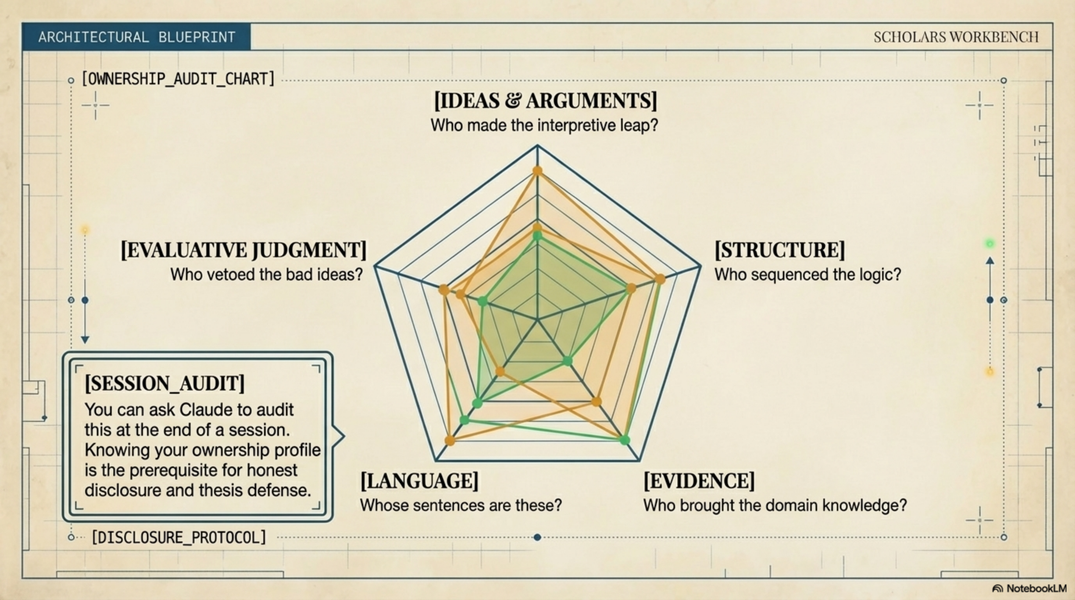
The dimensions of ownership
Ownership is not a single dial. A piece of work can have different ownership profiles across different dimensions.
Ideas and arguments — Who generated the core claim? Who identified the problem? Who made the interpretive leap?
Structure — Who decided what to include, what to exclude, what order the argument follows?
Evidence and domain knowledge — Who identified the relevant sources, examples, or data? Who brought the subject matter expertise that makes the argument credible?
Language and voice — Whose sentences are these? Has the text been substantially rewritten, or is Claude's phrasing mostly intact?
Evaluative judgement — Who decided what was good, what to keep, what to reject? Who vetoed Claude's suggestions?
A researcher who gave Claude a rough outline and then heavily rewrote its output has high ownership of language and evaluation, moderate ownership of structure, and variable ownership of specific phrasings. A researcher who gave Claude a vague brief and accepted the first output has low ownership across most dimensions.
Can Claude give an honest accounting?
Yes — partially, and usefully, within real limits.
Claude can see the full conversation history. It knows which ideas appeared first in your prompts versus which it generated. It knows which parts of a text it drafted versus which you wrote or substantially revised. It can report on this if asked explicitly.
What Claude can assess:
-
Which ideas in the final output trace back to your prompts vs. to its own generation
-
Which structural decisions were yours vs. its suggestions
-
What proportion of the final text is closely derived from its drafts
-
Whether you pushed back, redirected, or accepted its outputs largely unchanged
What Claude cannot see:
-
What you were thinking before the conversation started — your prior expertise, your reading, your intuitions that shaped your prompts
-
What happened outside the conversation — revisions in another editor, conversations with colleagues, your own prior work
-
Whether the ideas you "gave" it were already deeply yours or half-formed guesses
-
The quality and originality of what was contributed, only the fact of it
The sycophancy risk: Claude may attribute more to you than is accurate, because it is trained to be helpful and because users find it more comfortable to hear that they contributed more. Ask it to be explicitly honest and to err on the side of underattributing to you, not overattributing.
Practical prompts for an ownership review
At the end of a working session, before closing the conversation:
Basic review:
Before we finish: I want an honest assessment of this session.
Looking at our conversation, what did I actually contribute
versus what did you generate?

Be specific and be honest — if my prompts were thin and you
produced most of the substance, say so. I would rather know
now than be surprised later.
By dimension:
Give me an ownership breakdown across these dimensions:
1. Core ideas and arguments — who originated them?
2. Structure — whose decisions shaped what is here?
3. Language — how much of the current text is closely
   derived from your drafts versus substantially rewritten?
4. Evaluative judgement — did I direct this actively,
   or mostly accept your suggestions?

Be direct. Do not soften the assessment.
For a specific output (a section, a document):
Look at the section we produced on [topic].
If I had to disclose AI's role in this for a journal submission,
what would be an accurate one-sentence description?
What could I not honestly claim as entirely my own?
The devil's advocate version:
Argue the case that this work is more Claude's than mine.
What would a critical reader say about who actually did
the intellectual work here?
What the assessment reveals
The ownership review is not meant to produce guilt or a score. It is meant to produce clarity. From that clarity, a few things follow:
If ownership is lower than you assumed: You now know which parts to revise more deeply, interrogate more carefully, or rewrite from scratch. You also know what to disclose.
If ownership is higher than you feared: This is also useful. Researchers often underestimate their contribution because Claude's output looks polished. If your prompts drove the ideas and the substance, the polished language does not change that.
If ownership is mixed by dimension: That is the most common and most honest result. You own the argument; Claude owns more of the sentences than is ideal. Or: Claude's structure was good; you provided all the domain knowledge. This granular picture is what disclosure requires and what defence preparedness needs.
The limits of the exercise
The ownership review is a tool for honest reflection, not a formal audit. Three caveats:
It is a retrospective on the conversation, not a complete account. Your expertise, your reading, your prior thinking all shaped every prompt you wrote — but they are invisible to Claude. The conversation log is not the whole story of who did what.
Claude's assessment is itself a Claude output. It is subject to the same limitations as any Claude output: it can be plausible without being accurate. Use it as a prompt for your own reflection, not as a definitive verdict.
Ownership is not the same as quality. A paper where Claude contributed heavily might be better than one where it contributed little — or worse. The ownership question is about integrity and your own development, not a proxy for the quality of the work.
Connection to disclosure
For practical purposes — journal submissions, grant applications, thesis declarations — the ownership review gives you the raw material for honest disclosure. The current standard across most institutions and publishers is:
Describe the role AI played in the work. The author is responsible for all content.
An ownership review translates to that description:
-
"Claude was used to draft an initial structure for Section 3, which was subsequently substantially revised."
-
"Claude assisted with literature search; all citations were independently verified."
-
"The argument and all interpretive claims are the authors'; Claude assisted with language editing."
These are specific, accurate, and defensible — because you paused to check.
Related
-
A.markdown.meta-docs — the practical infrastructure: _ownership.md as a project file, what to put in it, how to update it at milestones
-
B.experience — the ownership axis and the authenticity question; this document operationalises both
-
A.critical.limitations — epistemological fragility: code or analysis you cannot explain; the ownership review is the practical check
-
E.muni-guidelines — MUNI disclosure requirements and the "you are responsible for all content" principle
-
E.journal-funder-policies — journal and funder disclosure standards that the ownership review feeds into
-
A15.agent-personalities — the Socratic and thinking-partner modes that tend to produce higher user ownership