From occasional query to orchestrated workflow: the spectrum of AI-assisted research
Most conversations about AI in research assume a single kind of user — usually either a complete newcomer or a sophisticated engineer. Neither maps well onto the range of people actually doing computational humanities work. This document offers a different frame: a spectrum of five positions, each representing a different relationship with AI tools, not just a different skill level.
The spectrum is useful because it separates two things that often get conflated: technical skill and structural integration. A researcher can be highly skilled at writing prompts but still operating at Level 1 — because every session starts cold and nothing carries forward. Conversely, a researcher who has set up persistent project context is operating at Level 2 even if their prompts are simple.
Where you are on this spectrum shapes what risks you face, what leverage you can extract, and what it would take to move forward.
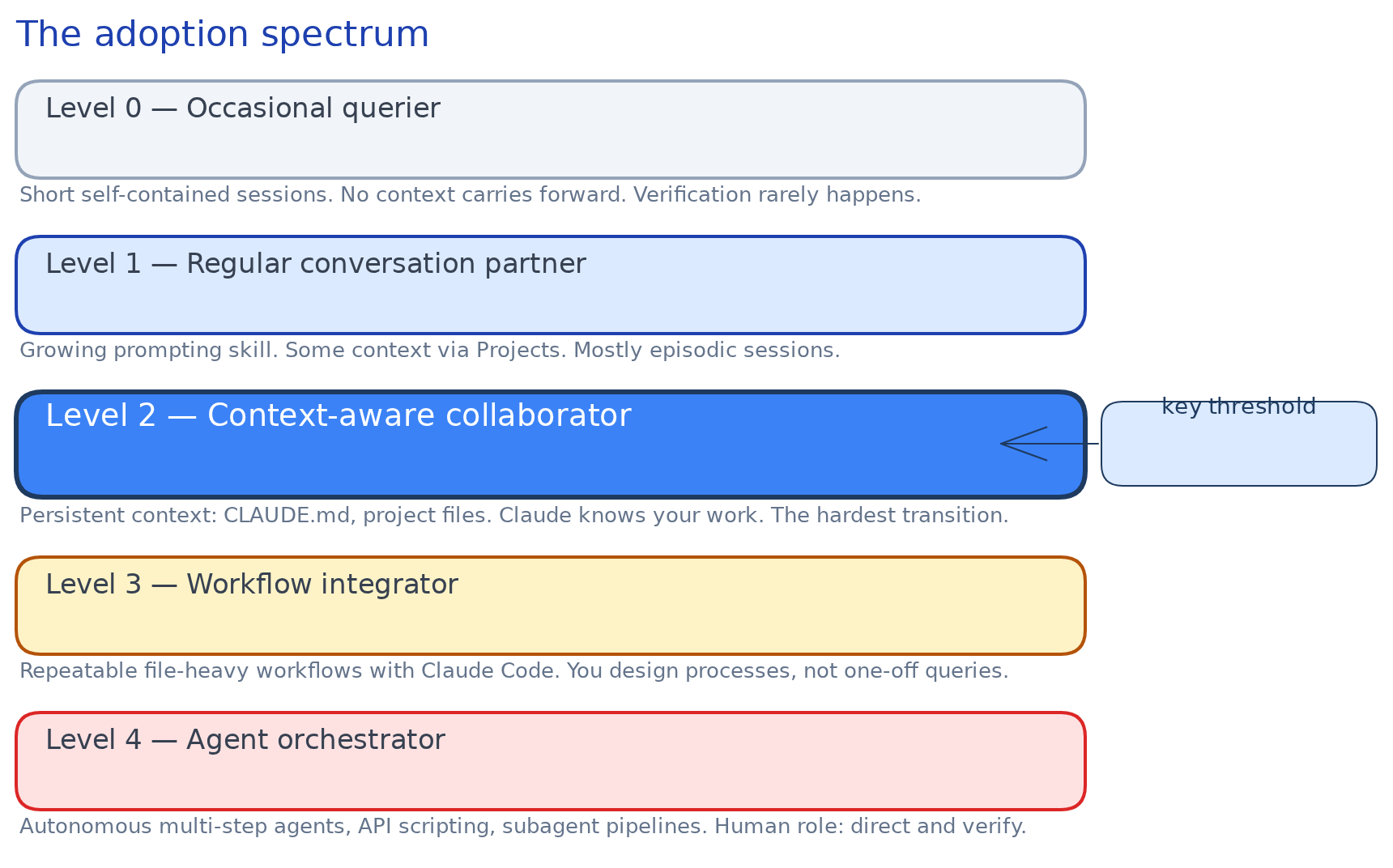
Level 0: Occasional querier
What it looks like. You open a web chat when you have a specific question. You treat Claude (or ChatGPT, or similar) roughly like an upgraded search engine — faster to parse, better at synthesis, able to explain things without requiring you to read ten sources first. Sessions are short, self-contained, and forgotten.
What it requires. Almost nothing beyond access and curiosity. The main skill is recognising when a question is worth asking.
What it produces. Isolated answers. Good for: quick definitions, checking whether you're using a term correctly, getting a first orientation to an unfamiliar field. Not useful for sustained work.
Characteristic risk. Treating AI output as a reliable reference. At this level, verification almost never happens — the session is over by the time the answer has been used. Hallucinations pass unnoticed.
Level 1: Regular conversation partner
What it looks like. You use AI habitually, not just occasionally. You've begun to develop prompting instincts: you know that context matters, that asking follow-up questions gets better results, that you need to specify audience and format. You may use Claude's Projects feature or memory to carry some context across sessions. But use is still largely episodic — each conversation is mostly self-contained.
What it requires. Willingness to iterate rather than accept the first answer. A growing sense of when to trust and when to push back. Patience with ambiguity.
What it produces. Better drafts, more interesting brainstorming, faster synthesis of material you already understand. The AI is a thinking partner for whatever is in front of you right now.
Characteristic risk. Sycophancy and confirmation accumulation. At this level, the AI is responsive but doesn't know your work deeply. It will affirm framings you bring to it. You can talk yourself into a bad argument faster than you'd expect. See B.epistemics.md.
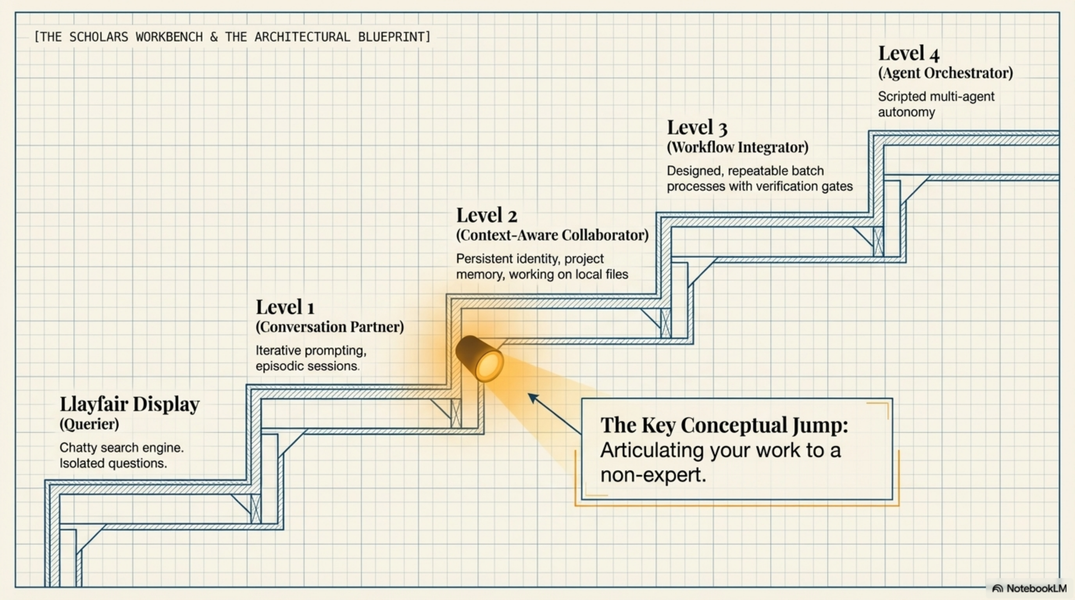
Level 2: Context-aware collaborator — the key conceptual jump
What it looks like. You have given Claude persistent identity context: a CLAUDE.md file (in Claude Code), a Project description (in Claude.ai), or an equivalent persistent system prompt. Claude knows who you are, what you're working on, what your goals and constraints are. You work on actual files and documents — not just pasted text — and the AI can reference your project's logic across sessions.
This level requires something uncomfortable: you have to articulate your own work clearly enough that an intelligent non-expert can understand it. That act of articulation is often more valuable than anything the AI produces in response. What you are doing here has a name: context engineering — building the information architecture Claude operates within, rather than crafting individual prompts. The leverage is different: instead of improving each request, you improve the foundation every request builds on.
What it requires. Sustained investment in context maintenance. Writing and updating a project description that actually captures what matters. A calibrated sense of Claude's strengths (synthesis, editing, structuring, analogy) and limits (finding novel sources, forming original research questions, reliable citation).
What it produces. An AI that responds to your project rather than to generic prompts. You can say "you know what I'm working on — what's the weakest section in this argument?" and get a genuinely useful answer.
Characteristic risk. Agenda drift and centroid capture. The AI now knows your project well enough to influence it. Its suggestions will be coherent with your framing — which is precisely what makes them dangerous. The centroid problem (Claude's picture of any field is its statistical average) becomes acute when Claude is shaping your thinking at the level of project design. See B.centroid-periphery.md and B.autonomy.md.
Level 3: Workflow integrator
What it looks like. You have designed repeatable AI-assisted workflows, not just ad hoc sessions. You use Claude Code for file-heavy work — processing a corpus of documents, maintaining a set of structured notes, cross-referencing sources systematically. You may use slash commands, templates, or custom instructions to standardise how you invoke AI for recurring task types. You have thought explicitly about when not to use AI as much as when to use it.
You think in terms of what the AI needs to do a good job, not just what you want to ask. The AI is a designed tool within your research process, not a chat partner.
What it requires. Comfort with Claude Code (or equivalent) and with the idea that the AI can act on your files. An ability to think in workflows: what is the input, what is the expected output, what does verification look like, where do I need to check the work? See B.lifecycle.md for how this maps to research phases.
What it produces. Repeatable leverage. The 40-document synthesis that would have taken two weeks takes two days. The coding protocol that would have been inconsistent across a team is now applied uniformly.
Characteristic risk. False systematicity. Repeatable workflows create an impression of rigour that the underlying AI outputs may not deserve. The interpretive judgments embedded in your prompts are invisible once they're in a template. Errors replicate at scale rather than staying isolated. See B.lifecycle.0.iteration.md for the micro-discovery loop that keeps this in check.
Level 4: Agent orchestrator
What it looks like. You program multi-step autonomous processes. You spawn subagents. You write scripts that call Claude's API, chain tasks, and handle outputs programmatically. The AI executes plans — not just individual tasks — and you direct rather than do.
This level requires genuine programming skill (or close, ongoing collaboration with someone who has it). The human role is now primarily: define the task clearly enough that it can be delegated, verify that what came back is what was wanted, and intervene when the agent goes wrong.
What it requires. Programming fluency, comfort with API integration, and — crucially — a high tolerance for reviewing outputs you didn't produce step by step. Agentic workflows surface errors in ways that are hard to catch: the chain completes, the output looks plausible, but something went wrong at step 3.
What it produces. Automation at a scale that changes what research is possible. See B.TH.institutional.use-cases.md for cases of institutionally-scoped work that wouldn't otherwise have been started.
Characteristic risk. Agentic risk: autonomous systems acting on your behalf in ways you didn't anticipate. This is the only level where the AI can cause downstream effects — file changes, API calls, published outputs — without you reviewing each step. Verification architecture must be built into the workflow design, not added afterwards. See C.dangers.md.
Most researchers belong at levels 2–3 — and that's exactly right
There's a pull toward Level 4 in how AI is discussed publicly. "Agent orchestration" and "autonomous workflows" sound more impressive than "I have a good CLAUDE.md." This is a distortion.
The highest-leverage gains for most humanities researchers come from Level 2 — getting persistent context right so that the AI responds to your actual work — and from selective Level 3 workflows for the file-heavy tasks that pile up at the edges of any project. Levels 2–3 cover the vast majority of the use cases described in B.usecases.md and B.TH.personal.use-cases.md.
Level 4 is valuable in specific circumstances: large-scale corpus work, systematic document processing, institutional tasks that are genuinely routine. But it is a tool, not a destination.
What moving up requires
The jumps between levels are not uniform.
0→1 requires habit and iteration practice. The main barrier is patience with imperfect outputs.
1→2 is the hardest conceptual jump. It requires you to articulate your own work — your project's logic, your working style, your epistemological commitments — clearly enough to be useful to a non-expert interlocutor. This is uncomfortable because it makes implicit things explicit. It is also one of the most valuable things AI-assisted research practice forces you to do.
2→3 requires comfort with Claude Code and workflow thinking. The main barriers are technical (getting Claude Code set up, understanding file-level permissions) and conceptual (thinking in repeatable processes rather than one-off conversations).
3→4 requires programming skill, or a close working relationship with someone who has it. This is a genuine threshold, not just a gradient — you either have the ability to write and debug scripts or you don't.
Related
-
B.experience.md — emotional texture at each level: control, ownership, overwhelm
-
B.autonomy.md — how autonomy erosion risk accumulates as level increases
-
B.epistemics.md — epistemic risks that peak at levels 2–3
-
B.usecases.md — concrete scenarios that map to levels 1–3
-
B.centroid-periphery.md — different levels appropriate for central vs. peripheral tasks
-
B.lifecycle.md — how research lifecycle phases map to different levels
-
B.team-ai.md — adoption asymmetry when a team spans multiple levels
-
C.dangers.md — risk categories organised by where they appear on the spectrum