B. Manuscript: Writing as Thinking, Thinking Through Writing
Purpose: Manuscript writing is not the phase where research gets reported. It is the phase where research gets its final shape. Writing is an interpretive act — one that reveals what you actually think, exposes gaps in what you thought you had established, and sometimes forces a redefinition of the whole project. This document treats the manuscript phase as the most powerful feedback mechanism in the research lifecycle, and describes how AI can support that process without displacing it. It also connects manuscript writing back to research question formation through the specific practice of proposal writing — even for internal use.
Part of the B.lifecycle series.
Writing is not reporting
The image of manuscript writing as reporting — the research is done, now you describe it — is a productive fiction of the final published text. It is not how manuscripts get written.
When you try to write a section and it does not work, that is information. When you cannot state your main argument in a single clear sentence, that reveals something about the state of your thinking. When the introduction and conclusion do not quite match — which they almost never do in a first draft — it reveals that the project has moved from its starting point in ways you have not yet consciously acknowledged. When a paragraph keeps getting rewritten and still does not say what you want it to say, the problem is usually not the paragraph. The problem is that you do not yet know what you want it to say.
This is not a failure state. It is how research produces its final intellectual shape. The argument you make in the manuscript is often different — sometimes substantially different — from the argument you planned to make when you designed the study. The difference is what you learned.
Writing makes this learning explicit. It is an epistemically productive activity, not just a communicative one. You do not write what you think. You think through writing.
The manuscript as diagnostic instrument
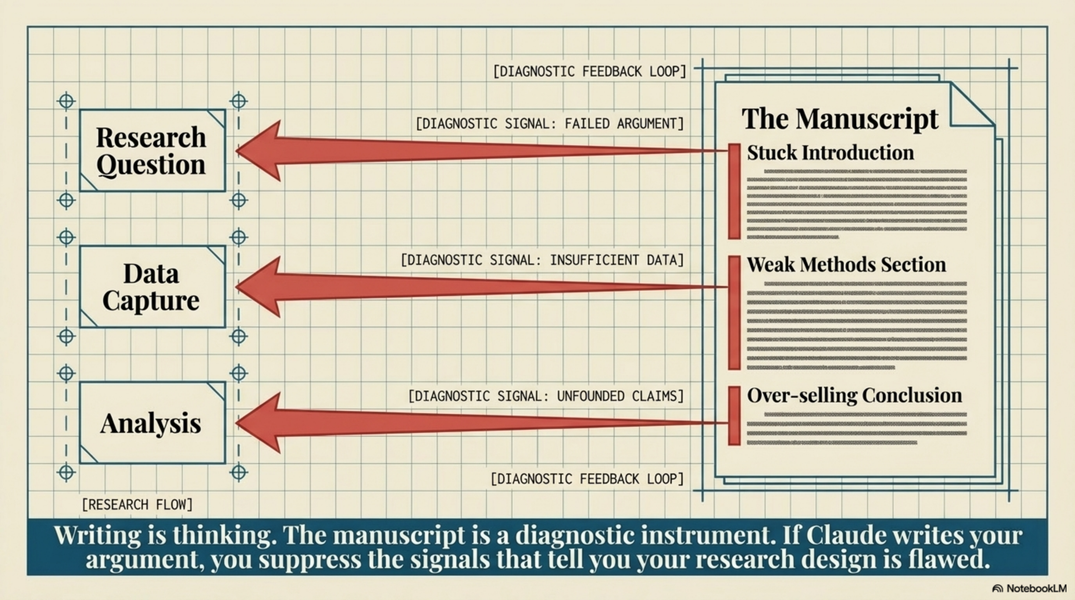
Every part of the manuscript that resists being written is signalling something.
The introduction you cannot complete reveals that you have not fully answered the question you set out to answer — or that you have answered a different question, and the introduction still points to the original one. The fix is not better sentences. It is either completing the research or updating the question.
The methods section you cannot make defensible reveals a gap in the data collection or a weakness in the research design that you papered over during the analysis phase. Writing it out forces the gap into the open.
The section you keep rewriting usually contains a claim you have not actually established — something you believe to be true, that follows logically from your hypothesis, but that the data does not directly support. The rewriting is an unconscious attempt to make the claim without the evidence. The fix is to either find the evidence or change the claim.
The discussion that goes in circles often means the findings do not have a clear implication yet. You have results; you do not yet know what they mean for the field. This sends you back to literature engagement: what does the existing literature actually say about this pattern, and what does your result add, complicate, or challenge?
The conclusion that oversells reveals the gap between what you found and what you hoped to find. The research is good; the conclusion is trying to make it mean more than it does. Trimming the conclusion and being honest about scope is both more honest and more credible.
AI can be genuinely useful as a diagnostic tool here: not to write around these signals, but to make them visible. "What is the weakest claim in this section?" "What evidence is this paragraph actually relying on?" "Does the conclusion follow from the analysis, or is it asserting something the analysis does not establish?" These are Socratic prompts, not requests for prose.
AI roles that work in the manuscript phase
Structure and organisation. Organising a complex manuscript — deciding the sequence of sections, managing the relationship between evidence and argument, ensuring the thread is visible throughout — is a task where AI assistance is productive. Claude can propose structures, identify where the argument is getting ahead of the evidence, and notice when sections are doing redundant work.
Prose mechanics. Grammar, sentence clarity, transitions, formatting, citation management. Low-risk and genuinely useful, provided you are reading what comes back carefully enough to notice when Claude has subtly changed the meaning of a sentence while improving its fluency.
Socratic feedback. The most valuable AI role in manuscript writing: "What would a sceptical reviewer object to in this argument?" "What is this paragraph actually arguing?" "Where is this section weakest?" "What does this claim require me to have shown, and have I shown it?" This is the mode that supports your thinking rather than replacing it.
Unsticking. When you are blocked on a section, describing the problem to Claude — what you are trying to say, why it is not working, what you have tried — is often more useful than asking Claude to write the section. The act of describing the problem frequently produces the solution. Claude's response may also be useful, but the diagnostic value of articulation is independent of it.
Checking consistency. Long manuscripts develop internal inconsistencies — a term used differently across sections, a claim in the introduction that contradicts a qualification in the discussion, a figure whose caption does not match the body text. Claude can be asked to check for these systematically.
AI roles that are fragile in the manuscript phase
Argument-building. The central intellectual act of the manuscript — deciding what to claim, how to sequence the reasoning, where to acknowledge limitations, how to make the contribution legible to readers — is yours. A manuscript whose argument was built by Claude is not your intellectual work in the sense that matters for peer review, academic standing, or honest disclosure.
Voice. Academic writing carries the author's intellectual personality. Claude's prose is recognisably Claude's — clear, well-structured, somewhat generic in register. Used extensively for drafting, it homogenises writing in ways that become apparent to close readers and that can make the text feel unowned. Use Claude for mechanics and structure; write the argument in your own words.
The central claim. What you are actually arguing — the one thing a reader should take from the paper — is not something Claude can determine. It can help you articulate it once you know it. It cannot tell you what it should be.
Writing as the final feedback loop
Manuscript writing is the most powerful feedback loop in the research lifecycle, because it requires you to make everything explicit simultaneously:
-
The question must be stated in a way that the paper actually answers
-
The method must be described in a way that justifies the analysis you conducted
-
The analysis must establish what the discussion claims it established
-
The contribution must be real and legible, not asserted
When any of these fail — and in a first draft, several usually do — the manuscript sends you back. Back to analysis (to find what the discussion needs but does not have). Back to data collection (to fill the gap the methods section reveals). Back to the research question (to align what you set out to answer with what you actually found). Sometimes, back to the literature (to engage properly with what the discussion is trying to say).
This is not failure. This is the research reaching its final shape through the discipline that writing imposes. The manuscript is the only phase where all parts of the project are simultaneously present and accountable to each other.
The connection to research question formation: writing proposals
There is a specific and underappreciated connection between manuscript writing and the earliest phase of the lifecycle — research question formation. It runs through the practice of writing proposals.
The proposal as a thinking tool, not just a funding document.
Writing a research proposal — whether for a grant, an institutional committee, or purely for yourself — forces you to do something that informal thinking rarely achieves: make everything explicit at once. You must state the question clearly enough for someone who does not share your background to understand why it matters. You must describe the method in enough detail that its fit with the question is visible. You must articulate the expected contribution in terms that are honest about what you will and will not be able to claim. You must admit, in the timeline, what is actually feasible.
This is the same discipline the manuscript imposes — but at the beginning of the project, when the cost of discovering gaps and contradictions is low, rather than at the end, when it is high.
The internal proposal: writing for yourself, with no submission in mind.
Even when there is no funder, no committee, no audience, writing a proposal-format document at the start of a project is a form of research thinking that informal planning cannot replicate. A two-page internal proposal — question, method, expected contribution, timeline — surfaces the vagueness and the unexamined assumptions that exist in every research plan before it has been written out. It is not bureaucratic overhead; it is intellectual clarification that makes the project more coherent before it begins.
AI in proposal writing.
Claude is genuinely useful for drafting research proposals, and the usefulness is dual: the output (a draft proposal) and the process (the act of trying to articulate the project clearly enough for Claude to work with). When a project description fails to produce a coherent proposal draft — when Claude asks clarifying questions you cannot answer, or produces something that clearly does not match what you meant — that failure is informative. The proposal is revealing that the research question is not yet clear, the method is not yet specified, or the contribution has not been thought through.
The productive sequence: try to write the proposal yourself first; use Claude to stress-test it ("What is weakest about this research design?" "What would a reviewer find unconvincing?"); revise in response to the critique; use Claude to help articulate the revised version more clearly. The intellectual content must be yours throughout.
The mid-project proposal.
Research projects drift. The question you started with is rarely exactly the question you end up answering. Writing a brief internal proposal at the midpoint of a project — after data collection has produced its surprises, before manuscript writing begins — forces you to articulate what you are actually doing now, rather than what you planned to do. This document becomes the bridge between the data you have and the manuscript you need to write. It is also the moment where the feedback loop between manuscript (5) and research question (1) becomes most visible: you may discover that the research question needs to be formally revised before writing can begin coherently.
Related
-
B.lifecycle — the full lifecycle and the iterative model; manuscript as the phase where all prior phases are simultaneously accountable
-
B.lifecycle.1.creativity — research question formation: the phase manuscript writing most commonly forces a return to; the 5↔1 feedback loop
-
B.lifecycle.4.dataanalysis — analysis as the source of provisional findings that manuscript writing must turn into defensible claims
-
B.lifecycle.2.literature — literature engagement that manuscript writing often reveals is incomplete
-
B.ownership — the manuscript is where ownership is most consequential and most visible; argument-building is the dimension where AI use requires the most caution
-
B.autonomy — voice homogenisation and argument delegation as the manuscript-phase autonomy risks
-
A.issue.bounding — scoping individual writing sessions: making each session tractable without losing the whole-manuscript view