Ethics and integrity: three decisions
Three decisions every researcher faces when using AI. Each has a clear answer for the typical case, and a harder edge for the atypical one. This document gives you the decision rule; the linked documents give you the full analysis.
Decision 1: Can I give this data to Claude?
The rule: If it contains personal data of living subjects, or falls under your research ethics approval, check before using any external AI tool. If you are at a Czech institution and it is sensitive research data, use e-Infra or another approved institutional tool.
| Data type | Desktop | Code (API) | e-Infra |
|---|---|---|---|
| Published sources, your own writing | ✓ | ✓ | ✓ |
| Pre-publication data (no personal data) | caution | ✓ better | best |
| Anonymised interview transcripts | check IRB | ✓ better | best |
| Identifiable personal data | no | no | required |
| Sensitive data under MUNI data security rules | no | no | required |
| API keys, passwords | never | never | n/a |
What MUNI's binding rule says: "Do not input personal data, confidential documents, or sensitive research data into non-approved tools." Claude (Desktop or Code) is not on the MUNI approved list for sensitive data. The approved tools for sensitive data are Microsoft Copilot (institutional), Google Gemini (institutional), and e-Infra AI Models.
The GDPR dimension: If you are an EU researcher, sending personal data to Claude means Anthropic becomes a data processor under GDPR and you become the data controller responsible for having a lawful basis. Anthropic's servers are in the US — cross-border transfer rules apply. For data covered by your ethics approval, read that approval before proceeding.
For historical research: GDPR personal data protections do not apply to deceased subjects. Institutional policies on unpublished research data still do — pre-publication database records and unpublished corpus data should go to Claude Code (API, not used for training) rather than Desktop.
The distinction that matters: "Local" does not mean data stays on your machine. Claude Code reads files on your disk and sends their contents to Anthropic's servers for processing. Nothing in Claude is truly local. Only a locally-run open-source model (via Ollama or similar) keeps data on your machine.
→ Full treatment: A.issue.privacy-security, E.muni-guidelines
Decision 2: Do I need to disclose this use?
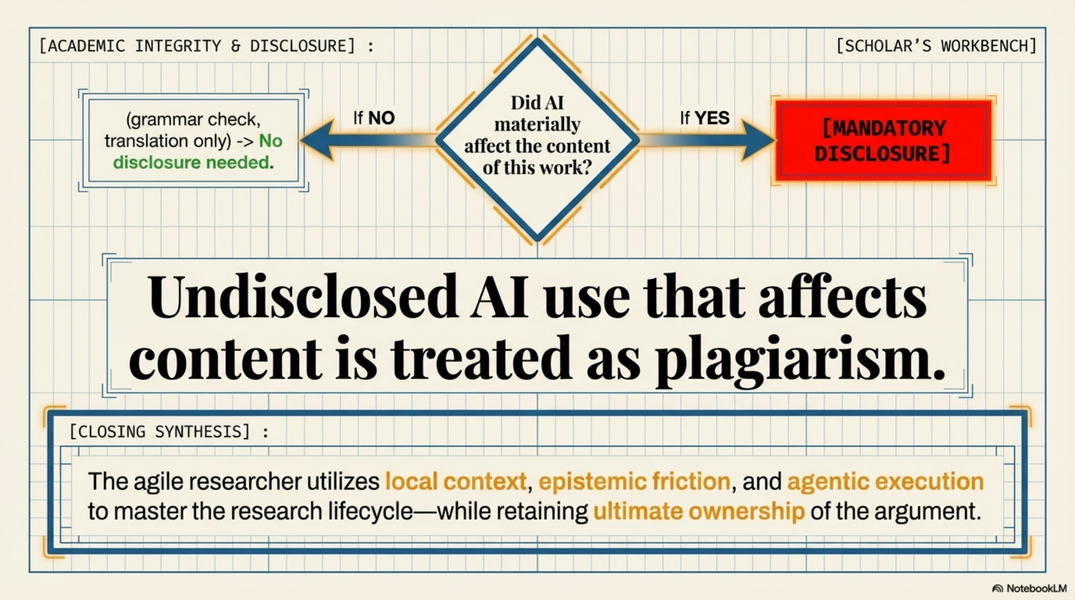
The rule: If AI materially affected the content of your work, disclose it. "Materially affected" means more than grammar checking or spell correction — it means AI contributed to the ideas, structure, argumentation, or text you are submitting.
What is universally agreed across publishers and funders: 1. AI cannot be listed as an author 2. You are responsible for all content, including any errors in AI-assisted sections 3. AI use in peer review is not permitted 4. Do not generate or manipulate research data with AI without disclosure
By institution and funder:
| Disclosure required? | Notes | |
|---|---|---|
| MUNI | Yes, when AI materially affects content | Four accepted forms: general declaration, in-text citation, methodology section, appendix |
| Horizon Europe | Yes, mandatory in 2025 forms | Non-declaration may render proposal ineligible |
| ERC | No mandatory disclosure | Full accountability for plagiarism; reviewers flag generic AI proposals |
| GAČR | No policy (March 2026) | Use institutional rules as reference |
| Most publishers (Springer, T&F, Sage, Wiley, Elsevier, Cambridge UP) | Yes, in methods or acknowledgements | When AI materially contributed |
| Oxford UP | Yes, including grammar/language tools | Strictest major publisher |
Safe baseline that works across all contexts:
"During the preparation of this work I used [tool name, version] for [specific purpose]. I reviewed and edited the content produced and take full responsibility for the final text."
What counts as "specific purpose": "for initial drafting of the literature review section" or "for reformatting interview transcripts into structured markdown" — not "for assistance." The more specific, the more credible and more useful to readers.
→ Full treatment: E.journal-funder-policies, E.muni-guidelines
Decision 3: Am I still the intellectual author?
The rule: You are the intellectual author when the ideas, arguments, interpretive judgments, and evaluation of evidence are yours — even if Claude drafted the text that carries them. You are not the intellectual author when you are presenting AI-generated conclusions you have not independently verified and judged.
The five dimensions of ownership:
| Dimension | Claude can contribute | Stays with you |
|---|---|---|
| Ideas / arguments | Develop, articulate, suggest alternatives | The claim itself and the judgment that it holds |
| Structure | Propose, reorganise, restructure | The decision that this structure serves the argument |
| Evidence / domain knowledge | Surface patterns, quote passages | The interpretation of what the evidence means |
| Language / voice | Draft, edit, improve | The decision that this is what you mean |
| Evaluative judgment | None | All of it |
Ownership is not a single dial — work can have different profiles across these five dimensions. A paper where Claude drafted text but not arguments has different authorship than one where Claude also generated the interpretive framing.
The practical test: Could you defend every claim in a seminar, citing the primary evidence, without relying on Claude's output? If yes, you are the intellectual author. If no, there is a gap worth addressing before submission.
The self-assessment prompt (use before submitting anything significant):
Before we finish: give me an honest accounting of this document.
What did you contribute? Where did my ideas constrain or shape what you wrote?
What claims in here should I verify independently before treating them as my own?
Note: Claude tends toward flattery in this conversation — push back if the assessment sounds too generous. Ask it to try harder to find the gaps.
→ Full treatment: B.ownership
The compound decision
These three decisions interact. The most ethically fraught scenario combines: (1) data you should not have sent, (2) use you did not disclose, (3) conclusions you are not sure are yours. Any one of these is recoverable. All three together is a structural integrity problem.
The reverse is also true. A researcher who shares only appropriate data, discloses clearly, and retains genuine intellectual authorship can use Claude extensively and with a clear conscience.
Related
-
A.adjacent.open-weight — the "only a locally-run open-source model" point, expanded: what open-weight actually means and when it's worth the effort
-
A.issue.privacy-security — full treatment of Decision 1
-
E.muni-guidelines — MUNI's data rules and disclosure requirements
-
E.journal-funder-policies — full treatment of Decision 2
-
B.ownership — full treatment of Decision 3
-
C.dangers — skill atrophy and autonomy risks that inform Decision 3